



Genuine Origin has been closely following Uganda’s progression as a specialty coffee producer for years. We’ve done this with the help of our sister company and sourcing partner in the region, Kyagalanyi Coffee Ltd. Uganda continues to astound everyone with improvements in cup quality. Moreover, they show determination to create impact on every scale. This includes small and large initiatives tailored for the diverse producing regions around the country.
Uganda Coffee at a Glance (2026 USDA)
- Production is at record highs: ~7.1–7.2 million bags projected for 2026/27
- Africa’s top exporter: ~6.8 million bags exported annually
- Still dominated by smallholders: ~90% of production
- Robusta leads: ~80% Robusta, ~20% Arabica
- Prices have surged: ~$4.5/kg export prices in 2025/26
- Domestic consumption is rising: ~335,000 bags
- Quality is improving fast: investments in washing stations + training
- Big opportunity ahead: strong demand + push for value addition
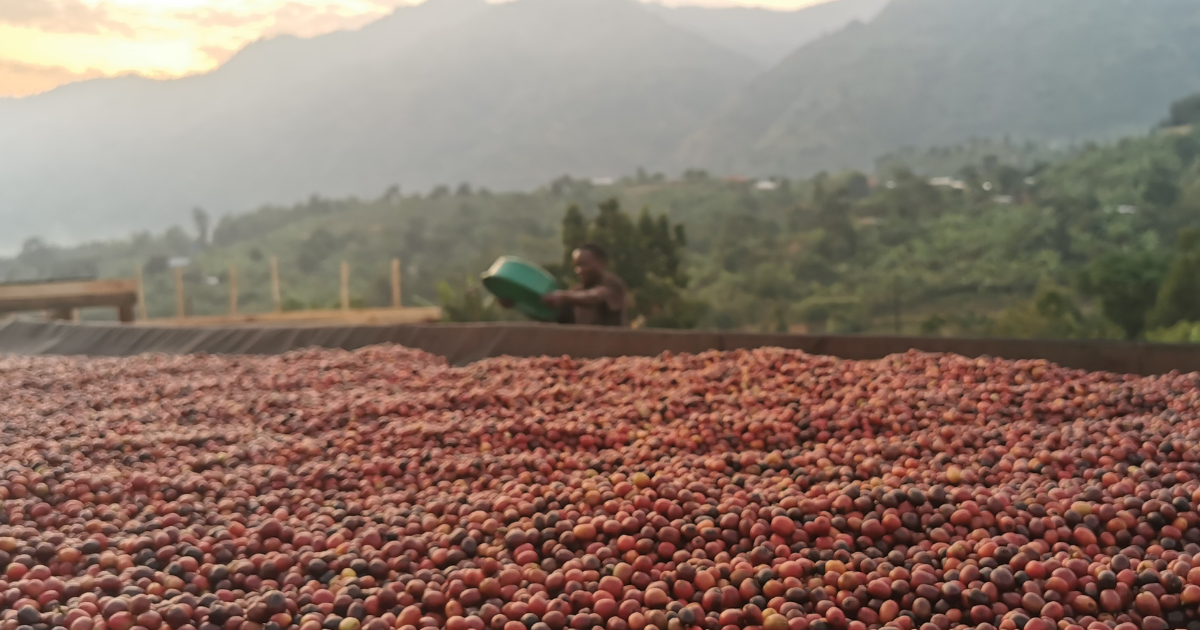
Uganda Coffee Cherries on raised beds
Uganda Coffee History
With a history dating back over a century, coffee has become deeply entrenched in the fabric of Ugandan society. It has shaped its economy, culture, and global reputation. It all began with wild Robusta, which grew natively throughout the shores of Lake Victoria. Robusta was domesticated by the Baganda people, who cultivated it in their household gardens.
Robusta coffee held significance for traditional and cultural ceremonies in the Buganda Kingdom. However, the arrival of Europeans in East Africa changed things. They colonized the kingdoms in the area, minimizing the importance of coffee. They even spread misinformation, claiming it was unhealthy. Eventually, coffee became a commoditized crop after losing its cultural significance.
Arabica coffee didn’t arrive in Uganda until the early 1900s when European and Asian settlers came. British colonists established large coffee plantations in Central Uganda. However, these collapsed in the 1920s in the aftermath of World War I. With the departure of the British, Ugandan smallholders took up coffee production themselves. The remaining infrastructure became the foundation for cash income for nearly 20% of the Ugandan population.
In the early 1990s, a wave of interest in Arabica began to take hold. Increased investment into the coffee sector found its footing in Mount Elgon and the Rwenzori Mountains. These areas had fertile volcanic soil and high altitudes better suited for growing Arabica. Today, Robusta coffee makes up around 80% of Uganda’s total coffee production, and Arabica makes up the remaining 15%.
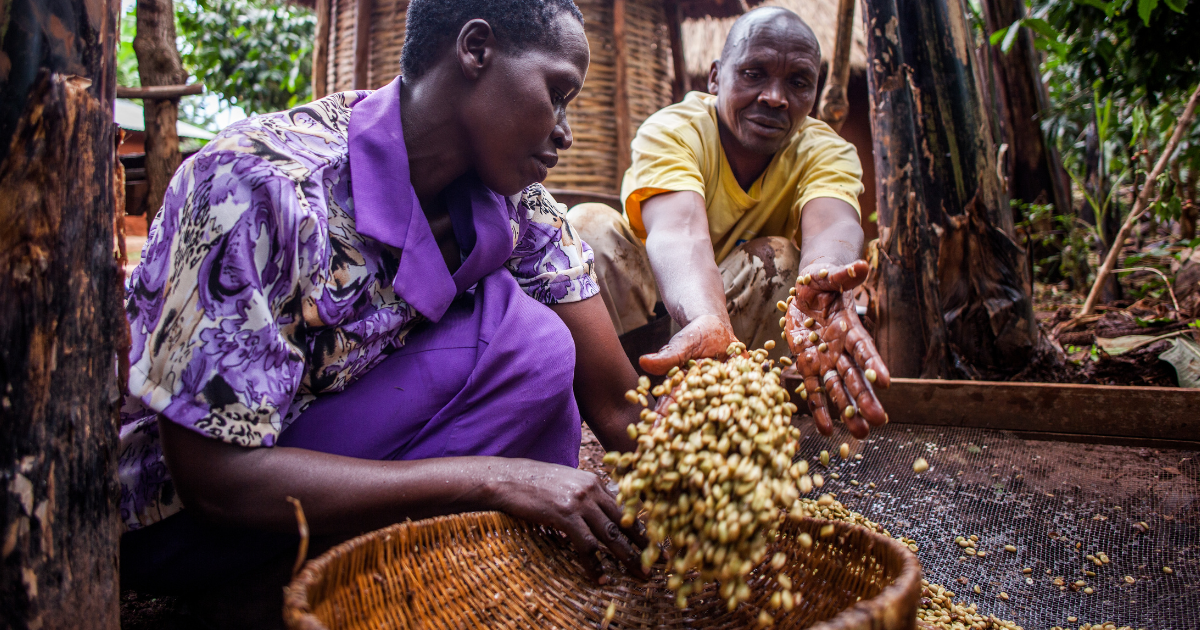
Ugandan coffee farmers with washed coffee
Uganda Coffee Production
While Ethiopia may be Africa’s top coffee producer, Uganda is the continent’s top exporter of coffee. And yet, they’re nowhere near their maximum potential.
In just a handful of years – despite challenges like the global pandemic and global logistics disruptions – Uganda’s production has continued to climb. According to the latest USDA Coffee Annual report, output is now projected to reach over 7.1 million bags, with further growth to ~7.2 million bags in the 2026/27 season.
This growth is supported by expanding farmland (now ~595,000 hectares planted), improved agronomic practices, and sustained high coffee prices, which are incentivizing continued investment across the sector.
Uganda exports roughly 6.7 – 6.8 million bags of coffee annually, reinforcing its position as Africa’s leading exporter. More than 98% is shipped as green coffee, primarily to the European Union, the United States, and emerging markets in Asia.
Uganda produces both Arabica and Robusta coffee, with Robusta accounting for around 80% of total production and Arabica making up the remainder. Robusta is primarily grown in the central lowlands, while Arabica thrives at higher elevations in regions like Mount Elgon and the Rwenzori Mountains.
Uganda’s coffee sector remains overwhelmingly smallholder-driven. Approximately 90% of production comes from smallholder farmers, who typically cultivate just 0.5 to 2.5 hectares of land.
At the same time, challenges remain. Rising input costs – particularly fertilizers, which have increased by roughly 21% in recent years – limit adoption among smallholder farmers. Pests like the coffee twig borer and diseases such as coffee leaf rust continue to impact yields across growing regions.
Meanwhile, strong global demand has pushed export prices significantly higher, increasing from roughly $2.50/kg in 2021/22 to over $4.50/kg in 2025/26, creating stronger incentives for farmers to invest in coffee production and quality improvements. And it’s working! There are top quality naturals and washed coming from Mt Elgon and the Rwenzoris.
For a deeper dive into production, exports, and pricing trends, explore our full breakdown of the Uganda USDA Coffee Report.
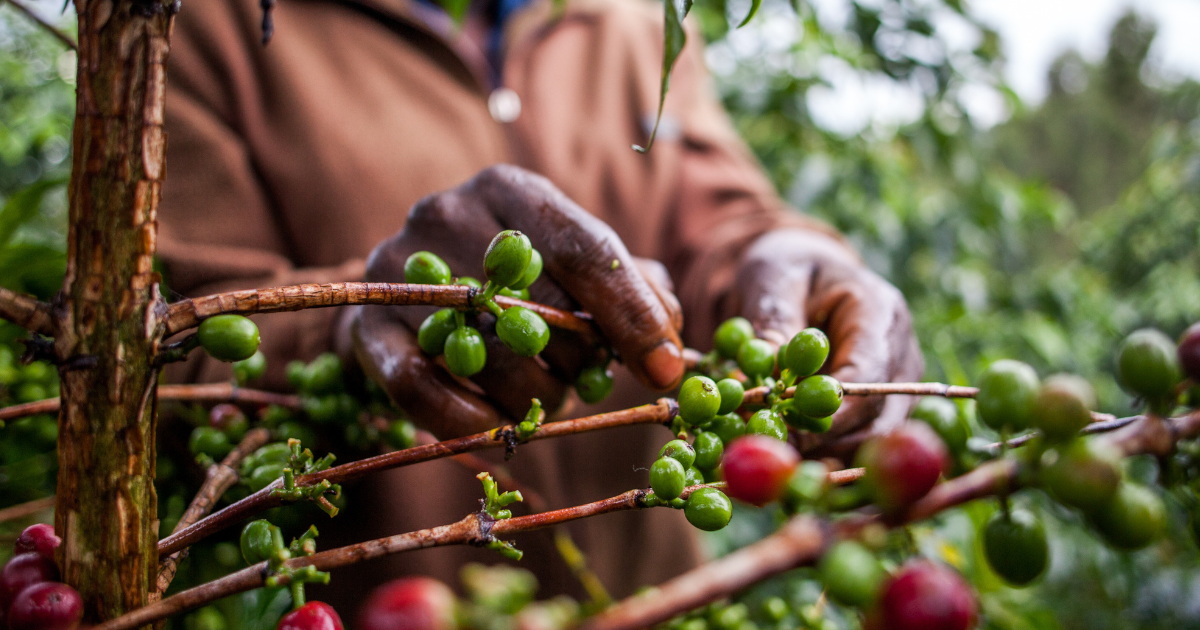
Picking ripe red coffee cherries in Uganda
Uganda’s Coffee Sector is Changing
Uganda is Africa’s up-and-coming specialty coffee powerhouse. Improvements in farming and processing are helping the region surge past socio-economic hurdles that have historically held this coffee origin back. Upgrades in quality and new washing stations are also substantially impacting the lives of the smallholder farmers who produce the coffee.
Coffee might only represent 20% of an average farm’s crops, but the money generated from it can account for up to 50% of the household’s annual income.
Uganda has a long-term Coffee Roadmap program aimed at increasing production and improving farmer incomes, alongside a broader push toward value addition. The government is actively encouraging investment in roasting and soluble coffee manufacturing, with the goal of capturing more value domestically rather than exporting only green coffee.
Domestic consumption is also rising steadily, now estimated at ~335,000 bags annually, driven by urbanization and growth in the hospitality sector.
One of the main constraints to achieving continued growth is farm productivity. With most farmers being smallholders, expansion is limited, making yield improvements critical.
Kyagalanyi works with over 26,000 households to address crop productivity through Volcafe support operations and continues to expand its reach each year.
At the same time, structural changes are underway. Uganda’s coffee sector remains highly export-oriented, but the industry is gradually modernizing through improved agronomic practices, better processing infrastructure, and stronger connections between farmers and exporters.
Together, these shifts are transforming Uganda from a volume-driven origin into a more dynamic, quality-focused producer – one that continues to evolve year after year.
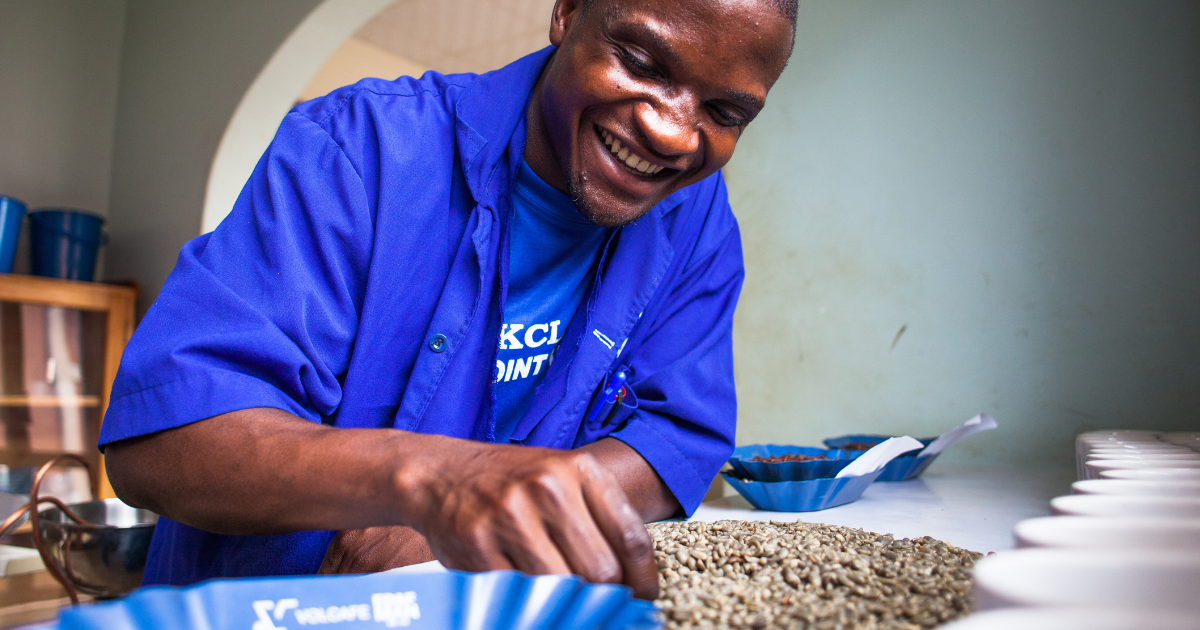
Uganda quality control manager with green coffee
Common Uganda Green Coffee Varietals
Robusta coffee is native to Uganda, and the two most common varietals found in the wild are known locally as Nganda and Erecta. Nganda is a Robusta varietal with high caffeine content and high sweetness that’s rare for a Robusta coffee. Erecta, on the other hand, is more neutral in flavor but also expresses a slight acidity. Research is being done on producing cultivars from these two strains to improve disease resistance, yield, and drought resistance.
The most common Arabica varieties found in Uganda are Kent, Typica, SL-14, and SL-28, taken from the neighboring countries of Ethiopia, Kenya, and Malawi.
While Coffea liberica, locally known as Kisansa, also grows natively in Uganda, it has yet to be traded commercially.
Uganda Green Coffee Producing Regions
From the verdant slopes of Mount Elgon to the fertile lands surrounding Lake Victoria, Uganda’s geographical diversity provides an ideal environment for coffee cultivation. Robusta is cultivated in the central and northern lowlands. Arabica coffee, however, grows mainly in three regions: the Rwenzori Mountains, Mount Elgon, and the West Nile.
The Rwenzori Mountains, also known as the Mountains of the Moon, sprawl across the border between Uganda and the Democratic Republic of Congo. Elevations span 1,500 to 2,300masl, with nitrogen-rich soil perfect for cultivating Arabica coffee.
On Mount Elgon, East Africa’s oldest volcano, coffee farms dot the slopes from 1,600 to 2,100masl, shaded by forests on the steep terrain. Donkeys are often employed to carry cherries from farm to mill.
In the West Nile region, ranging from 1,300 to 1,600masl, indigenous banyan trees provide shade to the coffee farms. Coffee is typically wash-processed here and has a citrusy character.
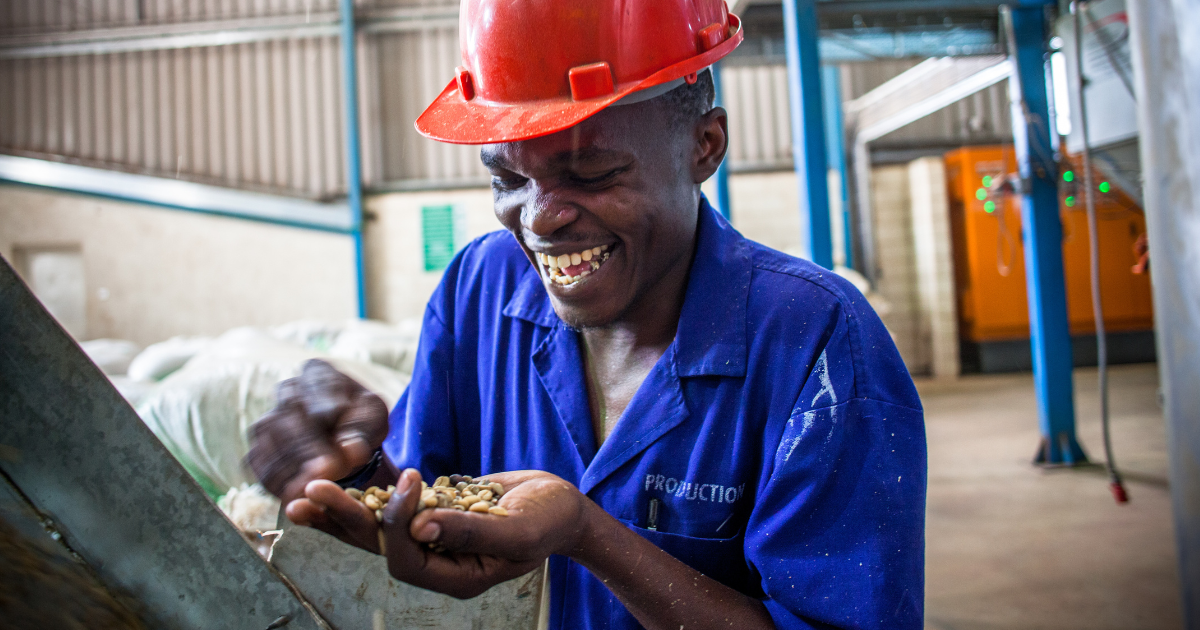
Warehouse in uganda – milling coffee
What is Bugisu coffee?
Bugisu coffee from Uganda is a classification of washed Arabica coffee from the sub-regions of Bugisu. Bugisu is a distinction of terroir and coveted for its winey, fruity character, including sweet notes of raisins and figs.
How are Uganda Coffee Beans Graded?
Arabica coffee from Uganda is graded based on screen size and number of defects, ranging from AA to CPB.
| Classification | Screen Size | Defect Tolerance |
| AA | 90% above 17 | 5% |
| A | 60% above 17 | 7% |
| A+ | 90% above 16 | 5% |
| B | 80% above 15 | 10% |
| PB | 80% above 15 | 10% |
| AB | 60% above 16 | 7% |
| CPB | 60% above 15 | 12% |
Ugandan green coffee can also be classified as drugar (natural dry Uganda Arabica), wugar (washed Uganda Arabica, not including Bugisus), or wur (washed Uganda Robusta).
Genuine Origin in Uganda
Founded in 1992, just after the coffee industry was liberalized in 1991, Genuine Origin’s sister company, Kyagalanyi, is one of Uganda’s oldest and largest coffee exporters. Even though producers have the freedom to market their coffee to buyers of their choice, poor public infrastructure and remote farm locations mean that options are limited. Kyagalanyi has been working for decades to change that; broadening market access is a crucial enabler for creating growth opportunities for the industry as a whole.
The Mount Elgon area is thriving; this eastern region borders Kenya, and the influx of investments and donations has stimulated the production of competitively high-quality coffee. Kyagalanyi has five regional washing stations and a team of 60 field staff in Mt Elgon. Between 2009 and 2018, Kyagalanyi reported an increase of 72% in coffee tree yields for their partner producers.
In West Nile, Kyagalanyi has done more than bring economic prosperity to an inaccessible and impoverished corner of Uganda. Household inspections are standard practice in Kyagalanyi’s farm certifications, and through that, there was a chance to create even more impact by advocating child education at the same time. Together with local NGOs and community partners, Kyagalanyi identified households where children were not in school and tackled the main hurdle for consistent enrollment: poverty.
Many households in Uganda cannot afford to pay the fees for school, uniforms, exams, and supplies, which served as a big motivator for Kyagalanyi to help increase their income from coffee. In 2018, Kyagalanyi was recognized with the Rainforest Alliance Sustainable Standard-Setter Award for its exceptional commitment to creating a child-labor-free zone. This success story further cements Kyagalanyi’s presence in Uganda as more than just a coffee exporter.
After averaging the numbers from increased yields, improved quality, and higher pricing for better quality, Kyagalanyi’s operations have created a staggering USD6.5 million in additional value each year for Mount Elgon and West Nile producers combined.
Over the past few years, three Volcafe nurseries in Rwenzori distributed over 100,000 seedlings to farmers, with the main variety being SL14. In order to encourage the sustainability of farming as a business, Kyagalanyi is doing all it can to stimulate and demonstrate better agricultural practices that lead to better livelihoods all around. There’s still a long way to go, but even in the short time since their presence in the region, Kyagalanyi has already made a considerable impact in prices for farmers who sell directly to them (+50–70%!).
Kyagalanyi’s efforts aren’t just limited to Arabica coffee either; with 60–70% of their exports being Robusta, they’ve expanded the Volcafe Way farmer support program and certification standards to Robusta farms, too. In Masaka, the UTZ/RFA initiatives will reach up to 5000 farmers in the next few years.
Although the Rwenzori’s are known for producing naturals, Genuine Origin is excited to see more fully washed coffee in partnership with Kyagalanyi. Processing methods that are still new to the region, like carbonic maceration and anaerobic fermentation, have been tried and tested at washing stations in the Rwenzoris as we continue to push coffee forward, and the opportunity for honeys to become a more common offering are in the works.
It’s inspiring to see communities, businesses, leaders, and producers come together to uplift Uganda’s coffee industry as a whole and change the world’s perception of a truly promising coffee origin. There is so much potential here, and coffee roasters can expect more variety in processing and increased quality for lots in Genuine Origin’s Uganda portfolio.